Skip to content
  • Home
  • Visit
    • Plan your Visit
    • Saint Louis Chess Campus
    • World’s Largest Chess Piece
  • Exhibitions
  • Programming
    • WCHOF Music Series:
    • Calendar
    • Chess: The Musical (at The Muny)
    • Artist Talks & Workshops
    • Family Activities
  • Halls of Fame
    • U.S. Chess Hall of Fame
    • World Chess Hall of Fame
  • Join & Give
    • Become A Member
    • Support the WCHOF
    • Join the Caïssa Club
    • Donate
    • Submit Your Stories
  • Shop
Menu
  • Home
  • Visit
    • Plan your Visit
    • Saint Louis Chess Campus
    • World’s Largest Chess Piece
  • Exhibitions
  • Programming
    • WCHOF Music Series:
    • Calendar
    • Chess: The Musical (at The Muny)
    • Artist Talks & Workshops
    • Family Activities
  • Halls of Fame
    • U.S. Chess Hall of Fame
    • World Chess Hall of Fame
  • Join & Give
    • Become A Member
    • Support the WCHOF
    • Join the Caïssa Club
    • Donate
    • Submit Your Stories
  • Shop
icon-search
icon-close
icon-menu

Wilhelm (William) Steinitz

(1836 – 1900)

U.S. Chess
Hall of Fame
Inducted
1987

World Chess
Hall of Fame
Inducted
2001

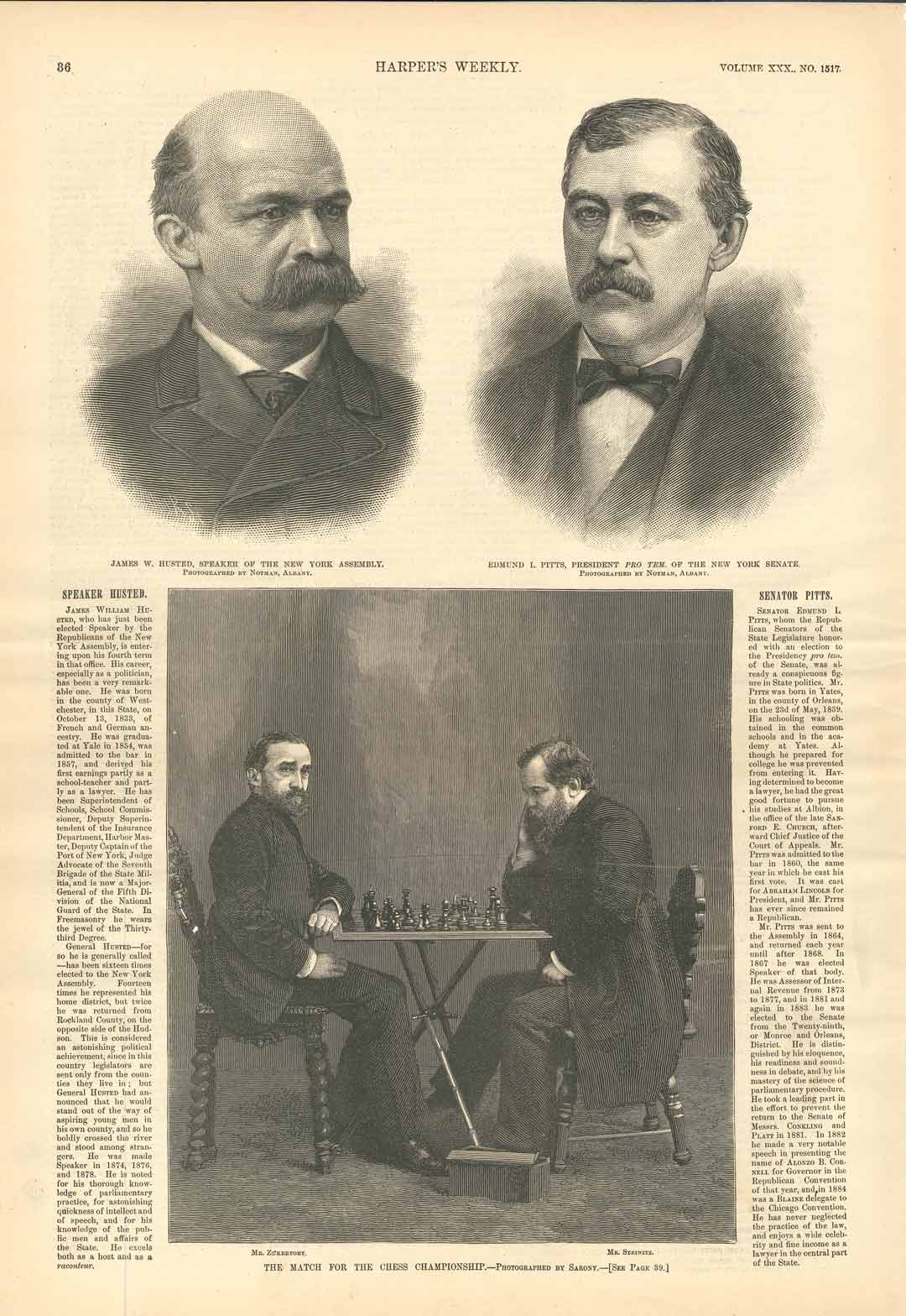
Born in Austria, William Steinitz was one of the most influential players, writers, and theoreticians in the history of the game. After beginning to play competitively in his 20s, he would win every serious match he played between 1862 and 1892, including victories against Adolf Anderssen and Johannes Zukertort.  In the early 1880s he came to the U.S. and settled in New York City shortly thereafter. He became the first official World Champion in 1886, following victory in a match against Johannes Zukertort played in New York, Saint Louis and New Orleans. He would hold the title until 1894, when he lost to Emanuel Lasker. His presence was a major factor in the development of chess in this country.

Steinitz’s contributions to chess theory were just as valuable to the game as his playing talent. Giving up an early reliance on attacking at all costs, he explained in a logical and specific way why methods of sound development and strategic planning were the keys to correct play. The theories of Steinitz, along with those of his contemporary Paul Morphy, are widely regarded as having laid the foundation for the beginning of modern chess. Indeed, his early observations and theories are still quoted as the foundations and basic principles of chess mastery.

Notable Games

Etching after Sarony
The Match for the World Championship
1885
Collection of the World Chess Hall of Fame

World’s Largest Chess Piece Live Cam

  • Plan your Visit
  • Exhibitions
  • Calendar
  • Become A Member
  • Plan your Visit
  • Exhibitions
  • Calendar
  • Become A Member
Open today until 9:00 p.m. Get Directions
Home

Get Connected

Receive news about our collection, exhibitions, events, and more.

4652 Maryland Avenue

Saint Louis, MO 63108 map

info@worldchesshstg.wpenginepowered.com | 314-367-WCHF (9243)

4652 Maryland Avenue
Saint Louis, MO 63108
map
info@worldchesshstg.wpenginepowered.com
314-367-WCHF (9243)
icon-facebook
icon-twitter
icon-insta
icon-youtube
icon-flickr
icon-yelp
  • Home
  • Visit
  • Exhibitions
  • Programming
  • Halls of Fame
  • Join & Give
  • Shop
Menu
  • Home
  • Visit
  • Exhibitions
  • Programming
  • Halls of Fame
  • Join & Give
  • Shop
  • About
  • History
  • Contact
  • Board & Staff
  • Careers
  • Affiliations
  • About
  • History
  • Contact
  • Board & Staff
  • Careers
  • Affiliations
  • Press
  • Collection & Donations
  • Blog
  • WCHOF
  • FAQ
Menu
  • Press
  • Collection & Donations
  • Blog
  • WCHOF
  • FAQ

Visit our partners

qboutique-logo_0_1.svg

Background Image: Austin Fuller​

© 2026 World Chess Hall of Fame | All Rights Reserved